Baseline assessment of farmer perception on the prevalence of red spider mites in smallholder vegetable production systems in The Gambia
DOI:
https://doi.org/10.26832/24566632.2026.110207Keywords:
Farmer perception, Integrated pest management, Pest prevalence, Red spider mites, Tetranychus urticaeAbstract
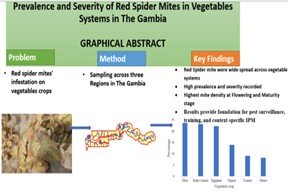
Red spider mites (genus Tetranychus) are among the most destructive arthropod pests affecting vegetable crops globally, particularly in tropical and subtropical production systems. Their rapid reproductive rate, extensive host range, and increasing resistance to acaricides make them a persistent constraint to vegetable productivity. This study aimed to assess farmer perceptions of the prevalence, severity, and crop growth stages associated with red spider mite infestations in smallholder vegetable production systems in The Gambia. A baseline survey was conducted in 2015 among 60 farmers randomly selected from six villages across three major vegetable-producing regions. Data were collected using structured questionnaires and analyzed with descriptive statistics. Results indicated that multiple vegetable crops were affected, with the highest infestation reported in okra (23.56%), bitter tomato (Solanum aethiopicum) (23.08%), and eggplant (22.12%), while tomato accounted for 9.13% of reported infestations. Infestations were most frequently observed during the flowering stage (42.31%), followed by maturity (32.69%). A majority of farmers (66.35%) perceived infestations as very severe, while 28.85% reported severe infestations. These findings confirm that red spider mites represent a significant production constraint in The Gambia. The study concludes that reliance on chemical control alone is unsustainable due to resistance development and recurring infestations. Strengthening integrated pest management (IPM) strategies, including biological control with predatory mites and the use of botanical pesticides, offers a novel and environmentally friendly pathway for sustainable management. This baseline evidence provides a foundation for future pest surveillance, farmer training, and the development of context-specific IPM packages to safeguard vegetable productivity and farmer livelihoods in The Gambia.
Downloads
References
Adesanya, A.W., Lavine, M. D., Moural, T. W., Lavine, L., Zhu, F., & Walsh, D. (2021). Mechanisms and management of acaricide resistance for Tetranychus urticae in agroecosystems. Journal of Pest Science 94, 639–663. https://doi.org/10.1007/s10340-021-01342-x
AFDB, African Development Bank. (2023). Environmental and social management framework for The Gambia. https://www.afdb.org
Bako, D., D’Orazio, M., Missiroli, S., Ssennono, V. F., Brunelli, C., Kilic, T., Ponzini, G., & Bolliger, F. (2022). Integrated sampling design for agricultural and socio-economic households surveys: Overview and application in Uganda Harmonized Integrated Survey. Statistical Journal of the IAOS, 38(1), 97–110. https://doi.org/10.3233/SJI-210905
Basha, H. A., Mostafa, E. M., & Eldeeb, A. M. (2021). Mite pests and their predators on seven vegetable crops. Saudi Journal of Biological Sciences, 28, 3414–3417. https://doi.org/10.1016/j.sjbs.2021.03.023
El-Karim, H., Rizk, M., & Mohamed, I. (2024). Biochemical and Morphological Characteristics of Leaves and their Relation with Infestation of Selective Piercing-Sucking Pests on Cucumber (Cucumis sativus), Okra (Abelmoschus esculentus) and Eggplant (Solanum melongena). International Journal of Agriculture and Biology, 31, 383-392. https://doi.org/10.17957/IJAB/15.2155
Espitia-Buitrago, P., Cotes Torres, J. M., Hernández, L. M., Cardoso, J. A., Chidawanyika, F., & Jauregui, R. N. (2025). Enhancing Phenotyping Accuracy for Selection of Urochloaspp. Tolerant Genotypes to Red Spider Mite (Oligonychus trichardti). Grass and Forage Science80, no. 3: e70007. https://doi.org/10.1111/gfs.70007
FAO, Food and Agriculture Organization. (2023). FAOSTAT statistical database. https://www.fao.org/faostat/
GADM. (2025). Database of Global Administrative Areas (version 4.1). https://gadm.org
Isman, M. B. (2020). Botanical insecticides in the twenty-first century: Fulfilling their promise? Annual Review of Entomology, 65, 233–249. https://doi.org/10.1146/annurev-ento-011019-025010
Jakubowska, M., Dobosz, R., Zawada, D., & Kowalska, J. (2022).A review of crop protection methods against the two-spotted spider mite (Tetranychus urticae)—With Special Reference to Alternative Methods. Agriculture, 12(7), 898. https://doi.org/10.3390/agriculture12070898
Kewedar, S., Chen, Q.-R., Moural, T. W., Lo, C., Umbel, E., Forrence, P. J., Walsh, D. B., & Zhu, F. (2025). Acaricide resistance monitoring and structural insights for precision Tetranychus urticae management. Insects, 16(5), 440. https://doi.org/10.3390/insects16050440
Kırışık, M., Erler, F., Boyaci, F., & Bayram, Y. (2020). Evaluation of resistance in 16 eggplant genotypes to the two-spotted spider mite, Tetranychus urticae Koch (Acari: Tetranychidae). Phytoparasitica, 49, 275 - 285. https://10.1007/s12600-020-00856-x
Mutthuraju, G. P., Srinivasa, N., Doddabasappa, B., & Ahmed, T. (2024a). Developmental biology and impact on yield loss caused by the two-spotted spider mite (Tetranychus urticae) in brinjal. International Journal of Advanced Biochemistry Research, 8(3), 166–169. https://doi.org/10.33545/26174693.2024.v8.i3b.711
Mutthuraju, G. P., Srinivasa, N., Doddabasappa, B., & Ahmed, T. (2024b). Effects of two-spotted spider mite (Tetranychus urticae) population density on yield loss and damage to brinjal crop. International Journal of Research in Agronomy, 7(3), 159–162. https://doi.org/10.33545/2618060X.2024.v7.i3c.397
Mutuku, B., Mwendwa, S. M., & Amwoka, E. M. (2024). Evaluation of selected crops for rearing predatory mite (Phytoseiulus persimilis), a predator of two-spotted red spider mites. Heliyon, 10, e38161. https://doi.org/10.1016/j.heliyon.2024.e38161
Nkiwane, M., & Tibugari, H. (2025). Evaluating the efficacy of garlic extract in managing red spider mites in tomatoes. International Journal of Research and Innovation in Applied Science, 10(6), 1385–1398. https://doi.org/10.51584/IJRIAS.2025.100600106
Singh, R. K., Behera, M. D., Das, P., Rizvi, J., Dhyani, S. K., & Biradar, Ç. M. (2022). Agroforestry Suitability for Planning Site-Specific Interventions Using Machine Learning Approaches. Sustainability, 14(9), 5189. https://doi.org/10.3390/su14095189
World Bank. (2024). Climate and biophysical characteristics of The Gambia. https://documents.worldbank.org
Xu, D., Zhang, Y., Zhang, Y., Dewer, Y., Wei, P. and Wang, S. (2026). Pesticide resistance evolution inTetranychus mites: from molecular mechanisms to sustainable management. 397– Entomologia Generalis, 46, 411. https://doi.org/10.1127/entomologia/3789
Ye, Q. T., Gong, X., Liu, H. H., Wu, B. X., Peng, C. W., Hong, X. Y., & Bing, X. L. (2024). The symbiont Wolbachia alleviates pesticide susceptibility in the two-spotted spider mite Tetranychus urticae through enhanced host detoxification pathways. Insect Science, 31(6), https://doi.org/10.1111/1744-7917.13341
Downloads
Published
How to Cite
Issue
Section
License
Copyright (c) 2026 Agriculture and Environmental Science Academy

This work is licensed under a Creative Commons Attribution-NonCommercial 4.0 International License.