Changes in agroforestry practices in response to climate change and associated factors in Mangsebung Rural Municipality, Ilam district, Eastern Nepal
DOI:
https://doi.org/10.26832/24566632.2026.110206Keywords:
Agroforestry, Climate change adaptation, Climate-resilience, Invasive speciesAbstract
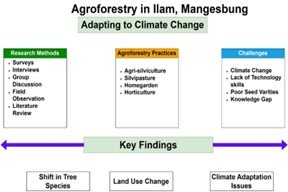
Agroforestry is a cornerstone of rural livelihoods in the mid-hills of Nepal, but its patterns are being reshaped by climate change and a set of associated socio-economic and technological factors. This study aimed to document the prevailing agroforestry practices, identify the drivers of change in those practices, and assess the contribution of evolving technologies in Mangsebung Rural Municipality of Ilam district in Nepal. A cross-sectional study was carried out using a structured household questionnaire, supplemented by key informant interviews, focus group discussions and direct field observations. Data was analyzed in Microsoft Excel using descriptive statistics. Results revealed that four major agroforestry practices were identified in the study area including home garden, horticulture-based agroforestry, agri-silviculture, and silvi-pasture. Climate change emerged as the most frequently cited driver of change, followed by market demand, community participation, government policies, and invasive species. Cardamom (under Alnus nepalensis), broom grass (Thysanolaena maxima), kiwi, and coffee have largely replaced traditional subsistence crops such as millet and barley, reflecting a marked transition from subsistence to commercial agroforestry. Major constraints include weather extremes, pest and disease pressure, irrigation scarcity, labor shortage, and weak institutional support. The study concludes that targeted policy support, climate-resilient species, and farmer training are required to sustain agroforestry-based livelihoods in the eastern mid-hills of Nepal.
Downloads
References
Aryal, K., Thapa, P. S., & Lamichhane, D. (2019). Revisiting agroforestry for building climate resilient communities: A case of package-based integrated agroforestry practices in Nepal. Emerging Science Journal, 3(5), 303–311. https://doi.org/10.28991/esj-2019-01193
Bhattarai, D., Devkota, A., & Sharma, G. B. (2025). Determinants and perceptions of women's participation in community forest management: Evidence from Western Nepal. Archives of Agriculture and Environmental Science, 10(4), 615–624. https://doi.org/10.26832/24566632.2025.100409
Braun, V., & Clarke, V. (2006). Using thematic analysis in psychology. Qualitative Research in Psychology, 3(2), 77–101. https://doi.org/10.1191/1478088706qp063oa
Cochran, W. G. (1977). Sampling techniques (3rd ed.). John Wiley & Sons.
Dahal, R. P., Kafle, S., Khanal, K., K.C., S., Subedi, M., Ojha, P., & Din, H. U. (2025). Agroforestry and traditional knowledge: Lessons from indigenous practices in South Asian countries: A review. Archives of Agriculture and Environmental Science, 10(1), 189–196. https://doi.org/10.26832/24566632.2025.1001027
Devkota, A., Upadhyay, I. K., & Wagle, B. (2025). Value chain analysis of Taxus (Yew) species and its affecting factors in Makwanpur district, Nepal. Archives of Agriculture and Environmental Science, 10(4), 677–686. https://doi.org/10.26832/24566632.2025.1004017
Dhakal, A., Maraseni, T. N., & Timsina, J. (2022). Assessing the potential of agroforestry in Nepal: Socio-economic and environmental perspectives. In J. Timsina, T. N. Maraseni, D. Gauchan, J. Adhikari, & H. Ojha (Eds.), Agriculture, natural resources and food security: Lessons from Nepal (pp. 375–394). https://doi.org/10.1007/978-3-031-09555-9_21
Gentle, P., & Maraseni, T. N. (2012). Climate change, poverty and livelihoods: Adaptation practices by rural mountain communities in Nepal. Environmental Science & Policy, 21, 24–34. https://doi.org/10.1016/j.envsci.2012.03.007
Jose, S. (2009). Agroforestry for ecosystem services and environmental benefits: An overview. Agroforestry Systems, 76(1), 1–10. https://doi.org/10.1007/s10457-009-9229-7
Khadka, D., Aryal, A., Bhatta, K. P., Dhakal, B. P., & Baral, H. (2021). Agroforestry systems and their contribution to supplying forest products to communities in the Chure range, Central Nepal. Forests, 12(3), 358. https://doi.org/10.3390/f12030358
Krueger, R. A., & Casey, M. A. (2014). Focus groups: A practical guide for applied research (5th ed.). SAGE Publications.
Lobell, D. B., & Field, C. B. (2007). Global scale climate-crop yield relationships and the impacts of recent warming. Environmental Research Letters, 2(1), 014002. https://doi.org/10.1088/1748-9326/2/1/014002
Mishra, A., Appadurai, A. N., Choudhury, D., Regmi, B. R., Kelkar, U., Alam, M., Chaudhary, P., Mu, S. S., Ahmed, A., Lotia, H., Fu, C., Namgyel, T., & Sharma, U. (2019). Adaptation to climate change in the Hindu Kush Himalaya: Stronger action urgently needed. In P. Wester, A. Mishra, A. Mukherji, & A. B. Shrestha (Eds.), The Hindu Kush Himalaya assessment: Mountains, climate change, sustainability and people (pp. 457–490). Springer. https://doi.org/10.1007/978-3-319-92288-1_13
Quandt, A., Neufeldt, H., & Gorman, K. (2023). Climate change adaptation through agroforestry: Opportunities and gaps. Current Opinion in Environmental Sustainability, 60, 101244. https://doi.org/10.1016/j.cosust.2022.101244
Rasul, G., & Molden, D. (2019). The global social and economic consequences of mountain cryospheric change. Frontiers in Environmental Science, 7, 91. https://doi.org/10.3389/fenvs.2019.00091
Sinclair, F. L. (1999). A general classification of agroforestry practice. Agroforestry Systems, 46(2), 161–180. https://doi.org/10.1023/A:1006278928088
Verma, K., Sharma, P., Bhardwaj, D. R., Sharma, V., & Thakur, P. (2024). Towards a greener future: Scaling up agroforestry for global sustainability. Green and Low-Carbon Economy. https://api.semanticscholar.org/CorpusID:269962817
Downloads
Published
How to Cite
Issue
Section
License
Copyright (c) 2026 Agriculture and Environmental Science Academy

This work is licensed under a Creative Commons Attribution-NonCommercial 4.0 International License.