Homegardens of Guinean Savannah Highlands of Adamawa in Vina, Cameroon: Woody floristic diversity and climate change mitigation potential
DOI:
https://doi.org/10.26832/24566632.2026.110201Keywords:
Carbon stock, Floristic diversity, Homegardens, Stand structureAbstract
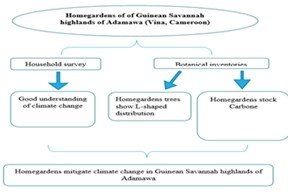
Homegardens stock carbon is crucial for climate mitigation. The aim of this study was to evaluate woody floristic diversity and climate change mitigation potential of homegardens in the Guinean Savannah highlands of Adamawa in Vina, Cameroon. For this, a household survey was conducted among 150 farmers in six villages. Botanical inventories were carried out in each village and the collected data was analysed in various ways. The results showed that the farmers populations have good understanding of climate change and have developed local mitigation strategies. In the homegardens of Vina, 1299 individuals were recorded, belonging to 39 species, 28 genera and 20 families. Tello locality had a greater number of individuals, species, genera and families than the other localities, with 309, 25, 22 and 19, respectively. The Shannon index of different locality was 1.92 in Malang and 2.42 in Bakari-bata. The homegardens in the Bakari-bata locality stored more carbon (175.38±136.96 tC/ha) and CO2 equivalent (643.67±502.66tCO2/ha) than other localities. According the age of homegardens, mature homegardens (between 30 and 40 years old) store a significant amount of carbon (175.16±93.49 tC/ha) and consequently CO2 equivalent (642.84±343.12 tCO2/ha). Thus, the results indicated the effectiveness of homegardens in mitigating climate change and contributed to the development of a database on REDD+ mechanisms in Adamawa region of Cameroon.
Downloads
References
Abayneh, L., & Negash, M. (2021). Species diversity, composition, structure and management in agroforestry systems: The case of Kachabira district, Southern Ethiopia. Heliyon, 7, e06477. https://doi.org/10.1016/j.heliyon.2021.e06477
Abebe, T. (2005). Diversity in homegarden agroforestry systems of Southern Ethiopia (Doctoral dissertation, Wageningen University). Wageningen University.
ADEME. (2015). L’agroforesterie, un outil « carbone » pour les PCET : Mettre en place une démarche d’agroforesterie sur le territoire d’un PCET. http://www.pcetademe.fr/domainesactions/agriculture/contexte-et-enjeux
Awazi, N. P., Tchamba, N. M., & Tientcheu, M. I. (2019). Climate change resiliency choices of small-scale farmers in Cameroon: Determinants and policy implications. Journal of Environmental Management, 250, 109560.
Berhanu, A., Demissew, S., Woldu, Z., & Didita, M. (2016). Woody species composition and structure of Kuandisha afromontane forest fragment in northwestern Ethiopia. Journal of Forestry Research, 28, 343–355.
Beyene Teklu Mellisse, Tolera, M., & Derese, A. (2024). Traditional homegardens change to perennial monocropping of khat (Catha edulis) reduced woody species and enset conservation and climate change mitigation potentials of the Wondo Genet landscape of southern Ethiopia. Heliyon, 10, e23631.
Bisht, S., Bargali, S. S., Bargali, K., Rawat, G. S., Rawat, Y. S., & Fartyal, A. (2022). Influence of anthropogenic activities on forest carbon stocks: A case study from Gori valley, Western Himalaya. Sustainability, 14(24), 16918. https://doi.org/10.3390/su142416918
Caballero-Serrano, V., et al. (2016). Plant diversity and ecosystem services in Amazonian homegardens of Ecuador. Agriculture, Ecosystems & Environment, 225, 116–125. https://doi.org/10.1016/j.agee.2016.04.005
Cairns, M. A., Brown, S., Helmer, E. H., & Baumgardner, G. A. (1997). Root biomass allocation in the world's upland forests. Oecologia, 111, 1–11.
Chave, J., Réjou-Méchain, M., Búrquez, A., Chidumayo, E., Colgan, M. S., Delitti, W. B. C., Duque, A., Eid, T., Fearnside, P. M., Goodman, R. C., Henry, M., Martínez-Yrízar, A., Mugasha, W. A., Muller-Landau, H. C., Mencuccini, M., Nelson, B. W., Ngomanda, A., Nogueira, E. M., Ortiz-Malavassi, E., Pélissier, R., Ploton, P., Ryan, C. M., Saldarriaga, J. G., & Vieilledent, G. (2014). Improved allometric models to estimate the aboveground biomass of tropical trees. Global Change Biology, 20, 3177–3190.
Cottam, G., & Curtis, J. T. (1956). The use of distance measurements in phytosociological sampling. Ecology, 37, 451–460.
Dangai, Y., Hamawa, Y., Tsobou, R., Oumarou, H. Z., & Mapongmetsem, P. M. (2021). Carbon stocks in Daniellia oliveri agroforestry parklands in the Sudano-Sahelian zone of Cameroon. Environmental Challenges, 5, 100397.
Eyzaguirre, P., & Bailey, A. (2007). International case studies and tropical homegardens projects: Offering lessons for a new research agenda in Europe. In A. Bailey, P. Eyzaguirre, & L. Maggioni (Eds.), Crop genetic resources in European homegardens (Proceedings of a workshop, 3–4 October 2007). European Cooperative Programme for Plant Genetic Resources (ECPGR).
Galhena, D. H., Freed, R., & Maredia, K. M. (2013). Home gardens: A promising approach to enhance household food security and wellbeing. Agriculture & Food Security, 2, 8. https://doi.org/10.1186/2048-7010-2-8
Garrett, H. E. G. (1997). Agroforestry: An integrated land-use management system for production and farmland conservation. United States Department of Agriculture, Soil Conservation Service.
Galluzzi, G., Eyzaguirre, P., & Negri, V. (2010). Home gardens: Neglected hotspots of agro-biodiversity and cultural diversity. Biodiversity and Conservation, 19(13), 3635–3654. https://doi.org/10.1007/s10531-010-9919-5
Gebru, E., Tolera, M., & Negash, M. (2020). Woody species composition, structure, and diversity of homegarden agroforestry systems in southern Tigray, Northern Ethiopia. Heliyon, 6(12), e05500.
Hamawa, Y. (2005). Caractérisations biophysiques des jardins de case chez les populations de Niza’a (Adamaoua, Cameroun) (Mémoire de DEA). Université de Yaoundé I.
Hu, R., Xu, C., Nong, Y., & Luo, B. (2023). Changes in homegardens in relocation villages: A case study in the Baiku Yao area in Southern China. Journal of Ethnobiology and Ethnomedicine, 19, 7. https://doi.org/10.1186/s13002-023-00578-4
Humbel, F. H. (1971). Carte pédologique de Ngaoundéré 1:50 000. ORSTOM.
Humnessa, T. (2020). Woody species diversity and composition of homegarden agroforestry practice in Dandi district, Central Ethiopia. International Journal of Engineering and Science Computing, 10(11), 27483–27488.
IPCC. (2003). Good practice guidance for land use, land-use change and forestry. Institute for Global Environmental Strategies.
IPCC. (2022). Climate change 2022: Impacts, adaptation and vulnerability. Cambridge University Press. https://doi.org/10.1017/9781009325844
Jama, B., & Zeila, A. (2005). Agroforestry in the drylands of eastern Africa: A call to action. World Agroforestry Centre.
Jose, S. (2009). Agroforestry for ecosystem services and environmental benefits: An overview. Agroforestry Systems, 76, 1–10.
Kassa, G., Bekele, T., Demissew, S., & Abebe, T. (2023). Plant species diversity, plant use, and classification of agroforestry homegardens in southern and southwestern Ethiopia. Heliyon, 9(6), e16341.
Kaye, J. P., Resh, S. C., Kaye, M. W., & Chimner, R. A. (2000). Nutrient and carbon dynamics in a replacement series of Eucalyptus and Albizia trees. Ecology, 81, 3267–3273.
Kent, M., & Coker, P. (2003). Vegetation description and analysis: A practical approach. John Wiley & Sons.
Kumar, B. M., & Nair, P. K. R. (2004). The enigma of tropical homegardens. Agroforestry Systems, 61, 135–152.
Kürsten, E. (2000). Fuelwood production in agroforestry systems for sustainable land use and CO2 mitigation. Ecological Engineering, 16, 69–72.
Lebrun, J. P., & Stork, A. L. (1991–1997). Énumération des plantes à fleurs d’Afrique tropicale (Vols. 1–4). Conservatoire et Jardin botaniques de la Ville de Genève.
Lejoly, J. (1993). Méthodologie pour les inventaires forestiers (flore et végétation). AGRECO-CTFT.
Letouzey, R. (1968). Phytogéographie du Cameroun. Lechevalier.
Luo, J., Li, Q., He, J., Yan, J., Zhang, S., Chang, X., & Wu, T. (2024). Local knowledge of homegarden plants in Miao ethnic communities in Laershan region, Xiangxi area, China. Journal of Ethnobiology and Ethnomedicine, 20, 37. https://doi.org/10.1186/s13002-024-00676-x
Mamah, M. (2005). Contraintes, opportunités environnementales et développement du village Idool (Adamaoua–Cameroun) (Mémoire de maîtrise). Université de Ngaoundéré.
Manaye, A., Tesfamariam, B., Tesfaye, M., Worku, A., & Guf, Y. (2021). Tree diversity and carbon stocks in agroforestry systems in northern Ethiopia. Carbon Balance and Management, 16, 14. https://doi.org/10.1186/s13021-021-00174-7
Mapongmetsem, P. M., Etchiké, D., & Ngassoum, M. B. (2016). Conservation and enhancement of biodiversity in the agroforests of the peri-urban area of Bafia (Central Region, Cameroon). Scientific and Technical Review Forest and Environment of the Congo Basin, 6, 60–69.
Mapongmetsem, P. M., Hamawa, Y., Baye-Niwah, C., Froumsia, M., Zigro, L., & Meiga, O. S. (2009). Conservation and enhancement of biodiversity in case agroforests in the Sudano-Guinean zone. In X. van der Burgt, J. van der Maesen, & J.-M. Onana (Eds.), Systematics and conservation of African plants (pp.
375–384). Royal Botanic Gardens, Kew.
Mapongmetsem, P. M., Ngassoum, M. B., & Etchiké, D. A. B. (2020). Potentialités des agroforêts contre les changements climatiques en zone d’écotone forêt-savane du Cameroun. European Scientific Journal, 16(15), 319–350.
Mapongmetsem, P. M., Nkongmeneck, B. A., Rongoumi, G., Dongock, Nguemo, D., & Dongmo, B. (2011). Impact des systèmes d’utilisation des terres sur la conservation de Vitellaria paradoxa dans les savanes soudano-guinéennes. International Journal of Environmental Studies, 68(6), 851–872.
Mandleni, B., & Anim, F. D. K. (2011). Climate change awareness and decision on adaptation measures by livestock farmers. In Proceedings of the 85th Annual Conference of the Agricultural Economics Society (18–20 April, Warwick University).
Maryo, M., Wolde, A., & Negash, M. (2023). Woody species diversity and carbon stock potentials in homegarden agroforestry and other land use systems, northern Ethiopia. Heliyon, 9, e19243.
Minasny, B., McBratney, A. B., Malone, B. P., & Wheeler, I. (2013). Digital soil mapping of soil carbon. Advances in Agronomy, 118, 1–47. https://doi.org/10.1016/B978-0-12-405942-9.00001-5
Montagnini, F., & Nair, P. K. R. (2004). Carbon sequestration: An underexploited environmental benefit of agroforestry systems. Agroforestry Systems, 61, 281–295.
Mori, S. A., Boom, B. M., De Carvalho, A. M., & Dos Santos, T. S. (1983). Southern Bahian moist forests. The Botanical Review, 49(2), 155–232.
Motis, T. (2007). Agroforestry principles. ECHO.
Nair, P. K. R. (1993). An introduction to agroforestry. Kluwer Academic Publishers.
Phondani, P. C., Maikhuri, R. K., Rawat, L. S., & Negi, V. S. (2020). Assessing farmers’ perception on criteria and indicators for sustainable management of indigenous agroforestry systems in Uttarakhand, India. Environmental and Sustainability Indicators, 5, 100018. https://doi.org/10.1016/j.indic.2019.100018
Pielou, E. C. (1966). The measurement of diversity in different types of biological collections. Journal of Theoretical Biology, 13, 131–144. https://doi.org/10.1016/0022-5193(66)90013-0
Piponiot, C., Cogné, M., Freycon, V., Thoumazeau, A., Gusmão, M., & Peltier, R. (2025). Traditional agroforestry systems in Timor Leste can store large amounts of carbon in both soil and biomass. Agroforestry Systems, 99, 138. https://doi.org/10.1007/s10457-025-01222-8
Seid, G., & Kebebew, Z. (2022). Homegarden and coffee agroforestry systems plant species diversity and composition in Yayu Biosphere Reserve, southwest Ethiopia. Heliyon, 8(4), e09281. https://doi.org/10.1016/j.heliyon.2022.e09281
Shannon, C. E. (1948). A mathematical theory of communication. Bell System Technical Journal, 27, 379–423, 623–656.
Shao, H., Hill, R., Xue, D., & Yang, J. (2021). In situ conservation of traditional vegetable diversity in Wa homegardens in southwestern Yunnan, China. Journal of Ethnobiology and Ethnomedicine, 17, 54. https://doi.org/10.1186/s13002-021-00479-4
Suchel, J. B. (1987). The climates of Cameroon (Doctoral dissertation). University of Bordeaux III.
Tebkew, M., Asfaw, Z., & Worku, A. (2023). Management strategies and floristic diversity in agroforestry practices of northwestern Ethiopia. Heliyon, 9(11), e20963.
Thorlakson, T., & Neufeldt, H. (2012). Reducing subsistence farmers’ vulnerability to climate change: Evaluating the potential contributions of agroforestry in western Kenya. Agriculture & Food Security, 1, 1–13.
Yinebeb, M., Lulekal, E., & Bekele, T. (2022). Composition of homegarden plants and cultural use in an indigenous community in Northwest Ethiopia. Journal of Ethnobiology and Ethnomedicine, 18, 47. https://doi.org/10.1186/s13002-022-00545-5
Zigro, L. (2005). Home gardens and biodiversity conservation among the Gbaya, Fulbe and Vouté peoples (Adamawa, Cameroon) (Master’s thesis). University of Ngaoundéré.
Downloads
Published
How to Cite
Issue
Section
License
Copyright (c) 2026 Agriculture and Environmental Science Academy

This work is licensed under a Creative Commons Attribution-NonCommercial 4.0 International License.